Midiplus
 Mandolins



Best Singing Microphone in India: What To Buy and Why (2026)

TL;DR: Singing is a lot louder than talking, and most budget microphones are built for talking. That is why so many of them sound clear during a test and then go harsh on the chorus. The spec that decides this is maximum SPL, which is how much loudness a microphone can take before the sound breaks up. If you want the short answer: the Kadence K111-V2 at ₹329 suits gentle and moderate singers, the K222 at ₹499 handles powerful voices, and the K333 at ₹999 is built for people who perform. All three are cardioid dynamic microphones, and they need no batteries or extra power. You can just plug them in and sing.
Quick comparison
| K111-V2 | K222 | K333 | |
| Price | ₹329 (MRP ₹799) | ₹499 (MRP ₹2,999) | ₹999 (MRP ₹1,499) |
| Best for | Practice, devotional singing, speeches | Powerful voices, shared use, small events | Performing, content creation, stage |
| Max SPL | 85 dB | 100 dB | High SPL for live vocals |
| Frequency response | 60Hz to 15KHz | 50Hz to 15KHz | 40Hz to 16kHz |
| Body | ABS plastic, metal grille | Alloy, metal grille | Die-cast metal, hardened steel mesh |
| Connector | 6.35mm jack, 10ft fixed cable | XLR male, XLR to 6.35mm cable included | 3-pin XLR male, 5m XLR cable included |
| Impedance | 150 Ω | 200 Ω | 600 Ω |
| Weight | 320 g | 380 g | 210 g |
| Shock isolation | No | No | Yes, internal capsule |
| Power needed | None | None | None |
All three carry a 1-year manufacturing defect warranty and a 7-day replacement window.
Why does a microphone sound fine in testing and bad at the function?
This happens constantly, and almost nobody works out the real cause.
You buy a microphone. You say “hello, testing” into it. Sounds clear. Then the karaoke night arrives, or the school function, or you finally sing the song properly, and on the big line the sound turns crunchy and slightly broken, like the speaker is straining.
Most people blame the speaker, the amplifier, or their own voice. Usually it is the microphone running out of room.
Every microphone has a ceiling on how much loudness it can turn into clean sound. Push past that ceiling and it does not simply get louder, it gets ugly. That ceiling is called maximum SPL, short for sound pressure level. Think of it as headroom.
Now the important bit. Speaking and singing are nowhere near the same loudness. A normal speaking voice is gentle. A person singing at full voice, four inches from the grille, is far louder than that. A microphone built with just enough headroom for announcements will handle your speaking voice beautifully and then run out of room at exactly the moment the song needs it.
So both statements end up being true at once: it did sound fine when you tested it, and it did sound terrible at the function.
What should you look for in a singing microphone?
Four things matter. The rest of the spec sheet is decoration.
Enough headroom for how loud you actually get
Match the microphone to your real singing volume, not your testing volume.
If you sing softly, meaning devotional songs, home practice, gentle riyaaz, then a modest ceiling is genuinely fine and you can stop worrying about it. If you belt, if you sing Bollywood playback style, if you are the one who takes the high note at every gathering, you need more headroom and you will hear the difference on the first chorus.
A cardioid pattern, so it hears your mouth and not your room
The polar pattern is the shape of the area a microphone listens to. You want cardioid, named because the shape roughly resembles a heart.
A cardioid microphone listens mostly to whatever sits directly in front of it and largely ignores the sides and back. Point it at your mouth, and the ceiling fan behind you mostly disappears.
There is a second benefit that shows up the moment you plug into a speaker, which is less feedback. Feedback is that screech you get when a microphone hears the speaker it is feeding into, and the sound loops round and round, getting louder each time. A cardioid microphone facing away from the speaker cannot hear it properly, so the loop never starts. If you have ever been at a function where the mic screamed at everyone, that was a feedback loop.
A dynamic design, so it needs nothing you do not own
There are two families of microphones, and the difference catches out a lot of first-time buyers.
Dynamic microphones are like a slightly hard-of-hearing friend. You have to lean in and speak up to be heard clearly. For singing that works in your favour, because the fan across the room is not leaning in. Dynamic microphones need no batteries and no external power.
Condenser microphones are the friend with unusually sharp hearing who catches every whisper, including the ones you wish they had not. They are excellent in a quiet, treated room. In a normal Indian home, they pick up the fan, the traffic, and your voice bouncing back off a tiled floor. They also need phantom power, which is 48 volts supplied by a mixer or audio interface. Without one, a condenser microphone will not even switch on. Plenty of people order one, plug it into their amplifier, and assume it arrived faulty.
Every microphone in this article is a cardioid dynamic. For singing at home, that is the correct choice rather than a compromise.
Metal where it counts
Microphones get dropped. They get passed hand to hand at family functions. They get thrown into a bag with the cable wrapped around them.
A metal body and metal grille are not vanity features at this price. They decide whether the microphone lasts four years or four months.
Kadence K111-V2 review: the best singing microphone under ₹500
₹329, reduced from ₹799
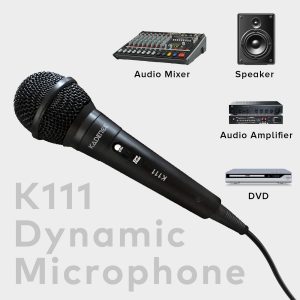
Specs: Cardioid dynamic, 60Hz to 15KHz, 85 dB max SPL, 150 Ω, moving coil capsule, ABS plastic body with metal grille, 6.35mm jack on a 10ft non-removable cable, 320 grams
This is the sensible first microphone. Its 60Hz to 15KHz range covers the human singing voice comfortably, and 85 dB of headroom is enough for home practice, devotional singing, speeches, classrooms, and small gatherings.
There is an ON/OFF switch on the body, so you can mute yourself between songs without walking across to the amplifier. Internal wind protection reduces the popping on hard “p” and “b” sounds. A clip for a standard mic stand is included, and the 6.35mm jack plugs straight into an amplifier or PA system.
Be honest with yourself about volume here. If you sing gently, this is all the microphone you need and the rest of this article is money you do not have to spend. If you belt, keep reading.
What you get in the box: microphone, fixed 10ft cable with 6.35mm jack, clip-on mic stand mount.
Buy this if: you are buying your first microphone, you sing at a moderate volume, or you want something dependable for practice, classrooms, and announcements.
Kadence K222 review: the best singing microphone under ₹1,000 for powerful voices
₹499, reduced from ₹2,999
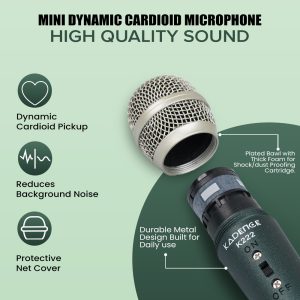
Specs: Cardioid dynamic, 50Hz to 15KHz, 100 dB max SPL, 200 Ω, moving coil capsule, alloy body with metal grille, XLR male output with XLR to 6.35mm cable included, 380 grams
This is where the headroom problem gets solved. Maximum SPL goes from 85 dB up to 100 dB, which is a serious jump. This is the microphone that stays clean on the line where the K111-V2 would start to strain.
Frequency response also widens downward to 50Hz, so it catches more low-end warmth in the voice. The body moves from plastic to alloy, with a metal grille and thick internal foam that deals with breath pops, dust, and minor handling knocks.
It uses an XLR connector at the microphone end. XLR is the three-pin locking connector used on professional stages worldwide, and the fact that it clicks in and stays put matters when someone walks past your cable mid-song. The included cable converts to a standard 6.35mm jack, so it still works with ordinary home amplifiers and karaoke systems.
One advantage does not show up as a number. The K222 is physically shorter and less bulky than a standard handheld. That reads as cosmetic until you hand a microphone to a nine-year-old at a school function, or hold one for forty minutes while hosting.
What you get in the box: microphone, XLR female to 6.35mm phono jack cable, clip-on mic stand mount.
Buy this if: you sing with real power, the microphone will be shared with children and students, or you want more headroom without spending four figures.
Kadence K333 review: the best singing microphone under ₹1,500 for performers
₹999, reduced from ₹1,499
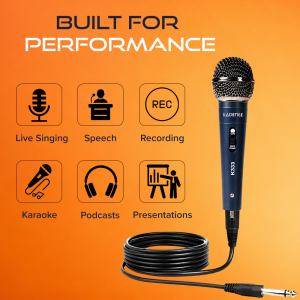
Specs: Cardioid dynamic, 40Hz to 16kHz, high SPL handling for live vocals, 600 Ω, moving coil dynamic capsule, die-cast metal body with hardened steel mesh grille, internal capsule shock isolation, built-in 3-pin XLR male with 5 metre XLR cable included, 210 grams
The newest of the three and the most capable. Frequency response is the widest here, running from 40Hz up to 16kHz for fuller lows and crisper highs, and it is rated for high SPL handling specifically for live vocals rather than a modest speech ceiling.
Two features separate it from the other two beyond the numbers.
The first is internal capsule shock isolation. The capsule inside sits cushioned from the body, so thumps and rustles from your hand shifting on the microphone do not travel through into the sound. On a cheap microphone, every hand adjustment is audible. On this one, mostly not. If you move while you sing, this matters more than any frequency figure on the page.
The second is the build. A die-cast metal body with a hardened steel mesh grille, made to survive handling, transport, and stage use. Despite all that metal, it weighs only 210 grams, the lightest of the three, because die-cast metal allows thinner walls than plastic does.
It ships with a 5 metre XLR cable rather than the usual three, which counts for more than it sounds like when the amplifier is across the room. It also works with wireless plug-on transmitters, so moving to a wireless setup later does not mean replacing the microphone.
What you get in the box: microphone, 5 metre XLR cable, mic stand mount.
Buy this if: you perform in front of people, you create content and want a microphone that looks right on camera as well as sounding right, or you want to buy once and stop thinking about it.
Which singing microphone should you buy?
Ask yourself one question. How loud do you get at your loudest?
Gentle to moderate. Practice, devotional songs, classroom use, speeches. Buy the K111-V2 at ₹329. Spending more will not make a gentle voice sound better.
Full voice, regularly. Karaoke nights, family functions, singing along with a PA system, sharing the mic with kids. Buy the K222 at ₹499. The extra headroom is the whole reason it exists.
Full voice, in front of an audience. Stage, worship, events, reels and streams where the audio has to hold up. Buy the K333 at ₹999. The shock isolation and the metal build are what you are actually paying for.
If two of these feel equally right, take the higher one. The gap between ₹329 and ₹999 is smaller than buying twice.
All three are available on the Kadence microphones page with free shipping, a 1-year manufacturing defect warranty, and a 7-day replacement window for manufacturing defects.
The free half of the answer
A microphone is only half of how you sound. The other half is technique, and technique costs nothing.
Sing close. Two to four inches from the grille. Cardioid microphones are designed to be sung into closely, and standing a foot back is the most common reason people decide their microphone is weak. The further back you go, the more room and less voice it picks up.
Sing across it, not into it. Angle the microphone slightly so your breath passes over the grille rather than straight into it. That removes most popping on “p” and “b” sounds without any extra equipment.
Stand behind your speaker, never in front of it. Point the back of the microphone at the speaker. That is the whole trick to avoiding feedback, because the cardioid pattern is deaf at the back.
Move the microphone before you touch the knobs. When feedback starts, repositioning solves it faster than turning everything down.
Hold a consistent distance. Drifting closer and further while you sing makes your volume jump around, and no microphone can fix that for you.
Common questions
Which is the best singing microphone for beginners? The K111-V2 at ₹329. It needs no setup, no power, and no accessories beyond what comes in the box.
Do these microphones need batteries or phantom power? No. All three are dynamic microphones. Plug in and sing.
Will they work with my home amplifier or karaoke system? Yes. The K111-V2 has a 6.35mm jack that goes straight in. The K222 and K333 use XLR at the microphone end, and both include a cable that converts to 6.35mm.
Can I plug these into my phone or laptop directly? Not directly. They are built for amplifiers, mixers, and PA systems. To record onto a computer, you need an audio interface or a mixer with USB in between.
Are these good enough for recording songs? For practice recordings, reels, and home recording, yes, especially the K333 through an interface. For professional studio work where you want every fine detail captured, a condenser in a treated room is the right tool. We would rather say that than sell you the wrong thing.
Can I use a singing microphone for speeches and events too? Yes, and they are very good at it. A microphone with enough headroom for singing has more than enough for speaking. It works in that direction but not the other way round, which is the whole point of this article.
What is the difference between the Home, Jamming, and Touring series? Home Series is for beginners, students, and hobbyists, and focuses on simplicity and value. Jamming Series is for intermediate users who need more features for rehearsals, content creation, and small live shows. Touring Series is for professionals who need advanced features and stage-grade reliability. All three microphones here are Home Series.
What warranty do they come with? A 1-year manufacturing defect warranty and a 7-day replacement window for manufacturing defects.
Quick Recap
- Singing is far louder than speaking, and most budget microphones are built for speaking. That mismatch is why they go harsh on the chorus.
- The spec that decides it is maximum SPL, the headroom before the sound breaks up. Judge a microphone at the volume you actually sing, not the volume you test at.
- You also want a cardioid pattern so it hears your mouth instead of your room, a dynamic design so it needs no phantom power, and metal where it counts.
- K111-V2 at ₹329 gives you 85 dB of headroom for gentle and moderate singers. K222 at ₹499 gives you 100 dB and an alloy body for people who really open up. K333 at ₹999 gives you high SPL handling, die-cast metal, and shock isolation for people who perform.
- Technique does half the work and costs nothing. Sing close, sing slightly across the grille, keep the speaker behind you.
Buy for the loudest you actually sing, not the quietest.
#Letsmusic