Midiplus
 Mandolins



Is the Kadence Slowhand Series is Actually Worth It?


Quick bit of trivia before we get into guitars: there’s a reason this series is called Slowhand.
Back in the mid-60s, Eric Clapton used to snap strings mid-gig. Instead of swapping to a backup, he’d just stand there and re-string in front of everyone. The crowd would fill the silence with a slow, sarcastic clap — a “slow handclap” — and the Yardbirds’ manager turned that into a nickname for the guy who was, ironically, one of the fastest players alive. You can read the full story here. He liked it enough to name a whole album after it.
We borrowed the name on purpose. Slowhand was never meant to be our “cheap” line or our “beginner” line. It was our attempt to build genuinely world-class guitars and then price them like they weren’t. Premium, for a bargain.
That’s a big claim, and the internet is (rightly) full of people asking whether it holds up. So let’s actually answer that.
TL;DR:
- Slowhand is Kadence’s premium, value-first series — the most guitar we can hand you for the money, not the cheapest thing on the shelf.
- It’s the only Kadence series with solid-wood options (real single-piece tops that open up and sound better as they age), alongside our signature demi cutaway body.
- Some models have a side sound port — we call it the Natural Monitor System — so you can actually hear yourself while playing.
- Rounded (not machine-cut) fret ends, better tonewood, and a comfortable neck are standard across the range.
- Prices run roughly ₹9,799 to ₹17,999, with the SH04 black spruce demi cutaway being the runaway bestseller.
- Fakes exist. Buy from kadence.in or trusted channel partners (Flipkart, Amazon, and quick-commerce like Zepto and Blinkit). Skip the sketchy discount sites.
“But is it actually worth it, or is it just marketing?”
This is the real question behind most Slowhand searches, so let’s be straight about it.
If you compare a Slowhand to a ₹3,000 first guitar, you’re not comparing the same thing. A lot of budget acoustics in India are all-laminate boxes — plywood pressed into a guitar shape with a thin printed veneer on top. They’ll get you through your first few chords, and there’s nothing wrong with that. But they sound how they sound on day one, and they’ll sound roughly the same on day 500.
Slowhand sits a level up. The idea was to take the stuff that usually only shows up on expensive imported guitars — solid tops, cleaner fretwork, real Fishman-style electronics, thoughtful body shapes — and put it inside a price a working Indian musician can actually justify.
So “worth it” depends on what you’re comparing it to. Against a throwaway beginner guitar, yes, it’s a clear step up. Against a ₹40,000 import, no, we’re not pretending it’s a Martin. It’s aimed squarely at the person who wants the feel and tone of a serious instrument without the serious-instrument invoice.
“I’ve never even heard of Kadence”
Fair. We’re not a 100-year-old American name, and we don’t pretend to be.
What we are is an Indian company that decided to stop just copying what worked abroad and actually try to improve it. The clearest example is our demi cutaway — and it’s worth understanding, because it’s the shape you’ll see across most of the Slowhand range.
For decades, guitarists were told to pick a lane. Want big, full, room-filling volume? Get a dreadnought, but live without easy access to the high frets. Want to reach those upper frets for solos and fingerstyle? Get a cutaway, but accept a bit less body and resonance. Nobody questioned the trade-off.
We did. The demi cutaway is a scooped dreadnought — a small contour carved into the upper shoulder that lets your hand slip up to the high frets, without hacking away the chunk of body that gives a dreadnought its boom. You get the volume and the reach. We wrote a whole piece on how that came about here, and honestly it’s the design we’re proudest of. The SH04 built on it sold out faster than we could restock.
The solid-wood thing (and why it genuinely matters)
Here’s the part people skim past, so slow down for this one.
Most affordable acoustics are laminate: several thin sheets of wood glued together, with a nice-looking veneer on the outside. Laminate is cheap, tough, and handles humidity swings well — legitimately useful in Indian weather. But all that glue stiffens the wood, so it vibrates less freely. The result is a sound that’s a bit flatter, a bit more “boxed in.”
A solid-wood top is a single continuous piece of tonewood. It vibrates as one surface, which is why solid-top guitars tend to sound fuller, more resonant, and more responsive to how hard or soft you play. And the payoff that laminate can never give you: solid wood ages. As you play it over months and years, the wood’s cell structure keeps loosening and settling, and the tone literally gets richer with time. People compare it to a pair of jeans wearing in, or wine improving in the bottle. A laminate guitar you buy today is as good as it’ll ever be. A solid-wood one is a slow burn that rewards you for sticking with it.
Slowhand is the only Kadence series that offers solid-wood models — the SH101PRO in solid spruce and the SHM100PRO in solid cedar sit at the top of the range for exactly this reason. If you’re the kind of player who’s going to keep this guitar for years, that’s the shelf to look at.
Quick way to spot solid wood yourself: peek at the rim of the soundhole. On a solid top, the wood grain flows in one continuous line over the edge and down inside. On laminate, you’ll see the tell-tale stacked layers, like plywood.
what are the holes on the side for?
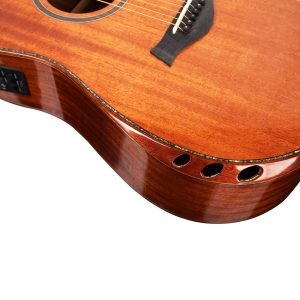
First thing to know: not every Slowhand has them. It’s the PRO models that do — the same solid-wood ones from the last section, like the SHM100PRO. (That “PRO” is just our shorthand for the top-of-the-range Slowhands.) The holes you see are the Natural Monitor System, a feature you’d normally only find on custom and boutique guitars.
Here’s the problem it solves. An acoustic guitar throws almost all its sound forward, off the top — toward the audience. Which is great for the audience, and slightly unfair to you, the player, sitting behind the instrument. You end up hearing the least flattering version of your own playing, and on a noisy stage or a loud room you can barely hear yourself at all.
A side sound port fixes that by aiming a slice of the guitar’s sound up toward your ears. Think of it as a built-in personal monitor — you finally hear the full, rich version of your tone, the same one everyone in front of you is enjoying. Players who busk, teach, or perform without stage monitors love it, because “hearing yourself” is half of playing in tune and in time. And here’s the neat part: a well-placed side port gives you a big boost while barely changing what the audience hears out front. You gain a monitor and lose almost nothing.
The small stuff that adds up
A few things you won’t see in the photos but will feel in your hands:
- Rounded fret ends. Cheaper guitars leave frets machine-cut with slightly sharp edges that catch your hand as you slide. Slowhand frets are rounded and smoothed, so the neck feels fast and comfortable over a long session.
- Better tonewood selection. Solid spruce tops with mahogany back and sides on the core models — chosen for warmth, sustain, and how they photograph, sure, but mostly for how they ring.
- A comfortable C-shaped neck and rosewood fingerboard, which is a big part of why people describe these as easy to play for hours.
- And yes — a truss rod. This comes up a lot online because there’s no cover on the headstock. The access point is inside the soundhole where the neck meets the body, which is completely standard. It’s a steel-string acoustic; of course it has one.
On the one honest criticism you’ll find in reviews — that some Kadence guitars can sound a touch bright or “shrill” — that’s partly voicing and partly strings. A lot of guitars ship with harder, brighter factory strings. If a Slowhand ever reads too bright for your taste, a set of phosphor-bronze strings warms it right up. Cheap fix, big difference.
How to make sure yours is the real thing
Because Slowhand built a reputation, counterfeits and dodgy “too good to be true” listings showed up — as they do for anything worth copying. A fake will cost you more in the long run than the genuine article ever would.
Two simple habits keep you safe:
- Look for the Slowhand signature. Every genuine model carries it. If a listing’s photos can’t show it to you, be suspicious.
- Buy from the right places. Straight from kadence.in is the surest route — you get the real instrument, the warranty, and the free learning course. Beyond that, our trusted channel partners are safe: Flipkart, Amazon, and on quick-commerce, Zepto and Blinkit. What you want to avoid is the random discount site you’ve never heard of, dangling a price that doesn’t make sense. That price doesn’t make sense because it isn’t real.
So, worth it?
If you want the cheapest guitar that exists, no — that was never the point of Slowhand.
If you want the most guitar for a genuinely reasonable amount of money — a solid-wood option that’ll sound better in five years than it does today, a body shape that stops making you choose between volume and playability, a built-in monitor so you can actually hear yourself, and fretwork that respects your hands — then yes. That’s the entire reason it exists.
Premium for a bargain. Slowhand by name, and hopefully in a guitar you’ll be re-stringing on stage for years.